
They had walked for three days without rest.
The column stretched along the narrow mountain path in a ragged line — hundreds of them, perhaps more, though no one had counted since the second night. Elders leaned on the shoulders of the young. Children were carried in silence, their faces pressed into the cloaks of parents who no longer had words of comfort to offer. Those who could still walk did so with the blank determination of people who had been told that stopping meant dying, and who had seen enough proof to believe it.
There had been a city once.
Not behind them — above them. A place among the clouds where the air tasted clean and the light fell differently, bending through towers of white stone in ways that made the world below seem pale and unfinished. A place where the energy that others called magic had a different name, an older name, and moved through the body like breath rather than fire. A place of balance.
That place was gone now.
Not destroyed. Taken. Emptied of its people and sealed behind walls of power that no longer answered to those who had built them. The boy did not understand why. He had heard fragments — arguments between the elders carried on the wind, his father’s voice low and tight in conversation with others, his mother’s hand gripping his shoulder whenever certain words were spoken. Words like betrayal. Words like exile. Words like war.
He understood only that they were no longer welcome in the sky.
And that the ground below had not been expecting them.
The forest had been safe for the first day. Dense canopy, soft earth, the sound of water somewhere nearby. His mother had smiled then — briefly, when she thought he wasn’t looking — and his father had walked with his shoulders straight, one hand resting on the hilt of a blade he had not yet needed to draw.
By the second night, the fires had started.
Not their fires. Something else. Something that moved through the trees with purpose, igniting trunks from within, turning the forest into a corridor of orange light and choking smoke. The column had broken apart. Families scattered. Screams rose and were swallowed by the roar of burning wood, and through the chaos came sounds that did not belong to fire.
Growling.
Low and guttural. Coming from between the trees.
The boy’s father had pulled him close and said nothing, which frightened him more than any words could have. His mother walked ahead, her steps quick and certain, following a path only she seemed to see. Behind them, others were not so fortunate. He heard steel ring against something hard. He heard a voice he recognised cry out and then stop. He heard the wet, heavy sound of something being dragged through fallen leaves.
He did not look back.
His father would not let him.
They ran.
The forest thinned as the ground rose beneath their feet, the earth turning from soft loam to loose stone and gravel. Trees gave way to exposed rock. The air grew colder. The smoke thinned but did not disappear, curling upwards from the burning woods below like fingers reaching after them.
And still the sounds followed.
Closer now. No longer hidden by the trees.
Eyes appeared in the darkness behind them. Several pairs. Red and unblinking, moving with a patience that suggested their owners knew there was nowhere left to run.
The boy’s mother reached the edge first.
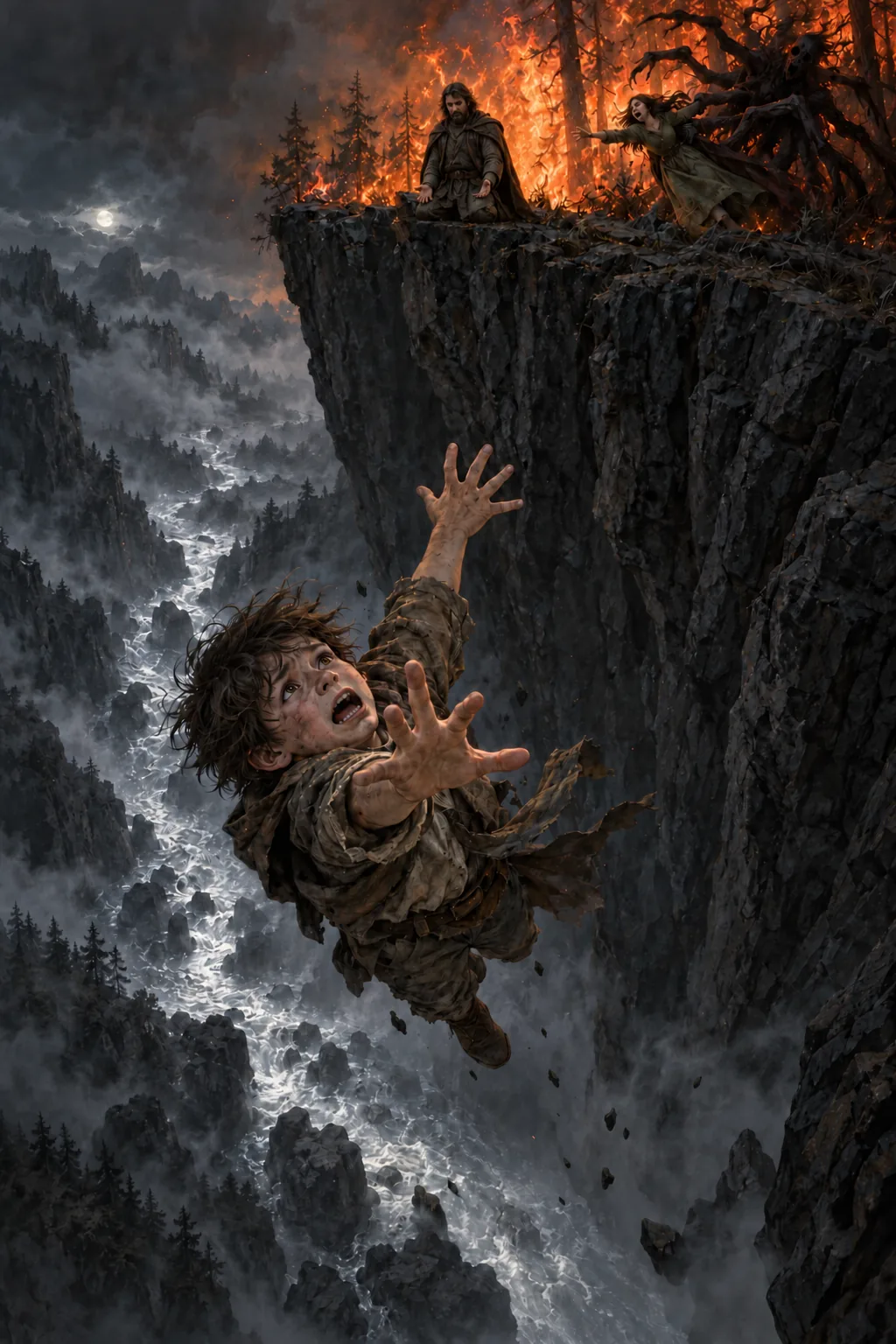
She stopped so suddenly that his father nearly collided with her. For a moment the three of them stood together at the lip of a cliff, the world falling away beneath them into a gorge so deep that the river at its bottom looked like a thread of silver winding between black stone. The water roared — distant but violent, white foam smashing itself against rocks that jutted from the current like broken teeth.
Behind them, the red eyes drew closer.
A branch snapped.
Something snarled.
His mother turned to his father. In the faint light of the burning forest below, her face held a look the boy had never seen before. Fear was part of it, but only part. It was the look of someone who had already made her decision and was now simply enduring the weight of it.
His father’s jaw tightened. He looked at the river. At the cliff. At the creatures closing behind them. Then at his son.
The boy saw his father’s eyes change.
Saw something in them break and harden at the same time.
His father knelt. The motion was slow, deliberate, as though he wanted to remember every second of it. He placed both hands on the boy’s shoulders and held him there, his grip firm and warm, his golden eyes — the same eyes the boy saw every time he looked into still water — steady despite everything.
“You are going to be brave now,” his father said.
The boy did not understand.
“You carry something no one else can,” his father continued. His voice did not waver, though something beneath it threatened to. “Something older than that city. Older than any of us. And one day, when you are ready, it will show you why.”
The boy shook his head. He wanted to speak, but his throat had closed.
“Everything we were goes with you.”
His mother knelt beside them. The tears came freely now — she did not try to hide them. She pulled the boy into her arms and held him with a fierceness that made his ribs ache, her face buried in his hair, her breath hitching against him in silent sobs.
She kissed his forehead.
Her lips moved against his skin. Words he could not hear. A prayer, perhaps. Or a promise. Or simply a mother saying the things that mothers say when they know it is the last time.
Then she pulled back.
She was smiling.
It was the most terrible thing the boy had ever seen.
His father lifted him. The boy felt the world tilt as strong arms raised him above the edge of the cliff. The wind rushed upwards from the gorge, cold and violent, tugging at his clothes, and far below the silver thread of the river churned and twisted between the stones.
“No—”
The word left him before he understood it.
His father’s hands released.
And the boy fell.
The sky spun above him. The cliff face blurred past — grey stone streaked with moss and shadow. His arms reached upwards, fingers stretched towards the two figures growing smaller above him, and in the last moment before the world became nothing but wind and water and the desperate hammering of his own heart, he saw it.
A shape moved behind his mother.
Something dark. Something with too many limbs. It reached from the tree line with terrible speed, and his mother’s silhouette jerked backwards as it took hold of her.
He screamed.
The sound was torn from his throat and swallowed by the roar of the gorge.
Then the river took him.
Cold hit his body like a wall. The current seized him and pulled him under, dragging him across stone and silt, filling his mouth, his ears, his lungs with freezing black water. He tumbled. He fought. He clawed towards something — anything — that might stop the world from spinning.
His fingers caught a root.
He held on.
Above, the cliff stood empty against the burning sky.
No voices called down to him.
No one came.
The boy clung to the root with both hands, his small body shaking, the river screaming around him, and stared upwards at the place where his parents had been.
The fire burned on.
The creatures howled.
And somewhere deep inside the boy — beneath the cold, beneath the terror, beneath the grief that had not yet found its name — something ancient stirred. A warmth that did not come from fire. A light that did not come from the burning trees. It pulsed once, faintly, like a second heartbeat, and then went still.
He did not understand it.
Not yet.
But it would wait.
It had been waiting a very long time.
The story continues in Chapter 1: Shadows and Signs.
Get the book